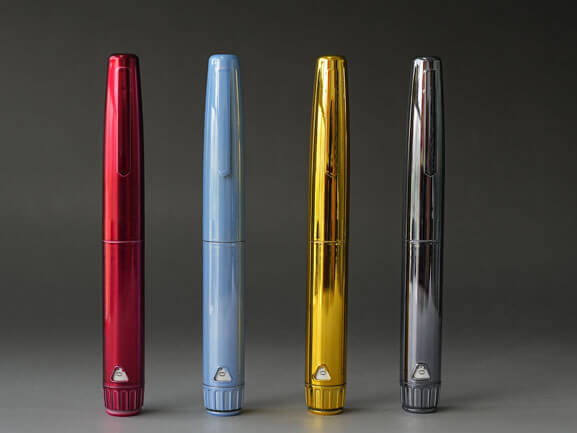
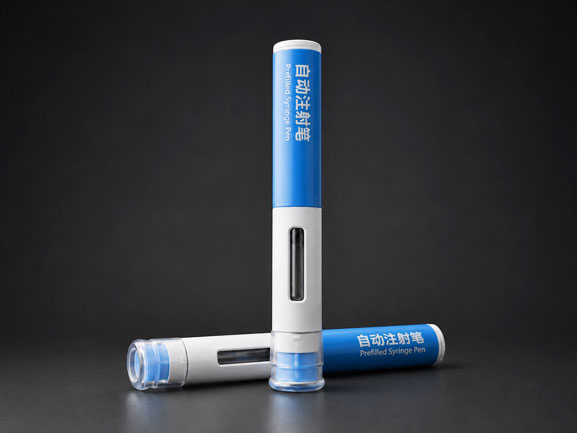
A peptide brand may already have a cartridge supplier, a target dose and a preferred metal pen appearance. That still does not establish that the cartridge and device can work together.
The phrase 3 mL cartridge describes nominal capacity, not complete device compatibility. A useful evaluation starts with drawings, dose calculations and the intended injection workflow. These eight checks help founders and R&D teams identify the information needed before requesting a quotation, sample or private-label design.
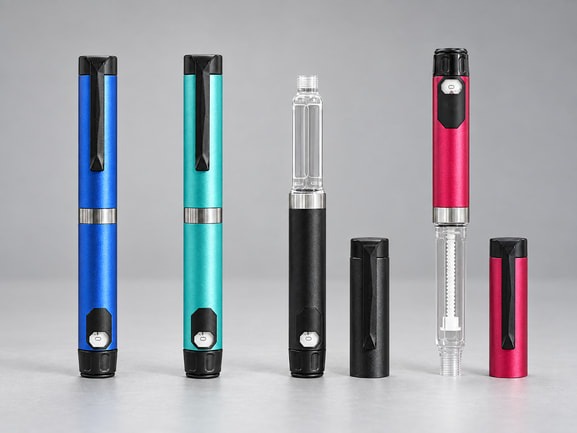
1 Review the Complete Cartridge Drawing
Compare overall length, body diameter, neck geometry, flange or closure features and dimensional tolerances with the cartridge holder. A nominal capacity match is not enough.
2 Confirm Stopper Geometry and Available Travel
The drive mechanism must contact and move the stopper through the required distance. Starting position, stopper length, friction and usable travel influence both delivered volume and end-of-cartridge behavior.
3 Define Fill Volume Headspace and Dose Count
The nominal cartridge capacity is not automatically the deliverable volume. Fill volume, headspace, priming allowance, residual volume and planned doses per cartridge should be considered together.
4 Translate Peptide Concentration into Device Dose
The pen scale must correspond to the actual relationship between drug concentration, prescribed amount and delivered liquid volume. A request for a 60-unit pen is incomplete without this conversion.
5 Match the Needle Interface
Confirm the intended pen needle drawing, connection and dimensions. Needle length and inner diameter can influence flow resistance, delivery time and the user experience.
6 Evaluate Viscosity and Injection Force
Formulation viscosity, stopper behavior, needle configuration and dose volume all affect the force needed to deliver the medicine. Metal housing alone does not reduce injection force.
7 Keep Container Compatibility in the Drug Program
The pen does not replace stability, container-closure, extractables or formulation compatibility work for the cartridge. Device selection and primary-container evaluation must remain connected.
8 Test the Complete User Workflow
Cartridge replacement, needle attachment, priming, dose setting, injection, needle removal and storage should be assessed for the intended users and use environment.
Compatibility Information to Send the Pen Supplier
| Project Input | What to Provide | Why It Matters |
| Cartridge | Dimensioned drawing and material direction | Establishes physical fit and holder interface |
| Stopper | Drawing, starting position and available travel | Supports drive contact and dose-travel review |
| Fill | Nominal fill, headspace and residual-volume assumptions | Helps estimate usable medicine and dose count |
| Dose | Concentration, minimum and maximum dose, increment | Connects the prescription to pen displacement |
| Formulation | Available viscosity range and use temperature | Supports injection-force and delivery-time planning |
| Needle | Selected needle drawing or technical specification | Defines interface and flow-resistance inputs |
| Users | Intended population and use environment | Frames usability and handling evaluation |
| Lifecycle | Expected cartridges, injections and years of use | Defines durability and service-life targets |
What a Sample Can and Cannot Confirm
An early sample can help teams compare size, grip, cap design, dose display and general handling. It cannot by itself confirm final dose accuracy, formulation compatibility, service life or regulatory suitability. Those conclusions require testing with the defined components and project conditions.
Conclusion
A metal reusable pen should be matched to the peptide product from the inside out. Cartridge and stopper geometry establish the mechanical starting point; concentration and dose define the required movement; viscosity and needle selection influence delivery; and the intended users determine whether the workflow is practical.
Xinfuda can begin an initial platform review using the cartridge drawing, dose table, formulation inputs and preferred metal pen configuration. Final specifications remain subject to project-specific testing and verification.


Copyright © Shijiazhuang Xinfuda Medical Packaging Co., Ltd. All Rights
MAKE AN ENQUIRY