Diagnostic test strips are frequently exposed to changing humidity during manufacturing, transportation, storage and repeated opening by the end user. For packaging engineers and IVD product teams, adding a desiccant is therefore only one part of the decision. The position of the desiccant, the container seal, available headspace, strip count and opening pattern all influence how the package should be evaluated.
Two common moisture-control formats are a test strip vial with a desiccant cap and an integrated desiccant vial with moisture-absorbing material molded into the inner wall. Both formats can be suitable for diagnostic test strip packaging, but they solve the packaging challenge in different ways. The better option depends on the product and filling project rather than on one structure being universally superior.
Why Desiccant Position Matters in Test Strip Packaging
When a vial is opened, humid ambient air enters the headspace. After the cap is closed, the packaging system must manage this introduced moisture as well as water vapor that may pass through the container and closure over time.
The rate at which the package returns to its target internal humidity can be affected by:
the type and amount of desiccant;
the exposed moisture-absorbing surface area;
the distance between the desiccant and the vial headspace;
container and closure moisture-vapor transmission;
strip count and remaining headspace;
the number and duration of opening cycles;
filling-room humidity and initial moisture load;
transport and storage temperature and humidity.
This is why absorption percentage alone is not enough to select a test strip vial. The complete container-closure system should be evaluated under the intended filling, storage and in-use conditions.
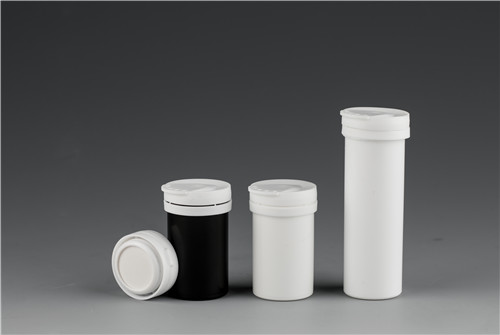
Option 1: Test Strip Vial with Desiccant Cap
A desiccant cap places silica gel, molecular sieve or a selected blend inside a protected cap chamber. A permeable barrier allows moisture in the vial headspace to reach the desiccant while helping prevent direct contact between the desiccant and the strips.
This is a mature format for glucose test strips, urinalysis strips, pH strips and other moisture-sensitive diagnostic products. It is available in multiple vial heights, cap diameters, desiccant loadings and closure configurations.
Main Advantages of a Desiccant Cap
Mature packaging format: Standard vial and cap combinations can shorten early-stage packaging selection.
Flexible desiccant loading: The cap chamber can be designed for different desiccant weights and materials.
Headspace moisture control: The desiccant is positioned near the opening, where humid air enters during use.
Functional closure options: Spring elements, tamper-evident structures and other closure features can be discussed according to the project.
Cost and sourcing flexibility: Existing sizes may reduce tooling requirements for conventional test strip projects.
Automation compatibility: Preassembled desiccant caps can be evaluated for automated capping lines without adding a loose sachet to each vial.
Points to Evaluate
The cap chamber occupies part of the closure volume, so usable headspace and strip fit should be confirmed. The desiccant barrier, cap sealing surface and opening force also need to be evaluated after repeated opening and closing. For projects with frequent daily use, humidity recovery after each opening cycle is especially relevant.
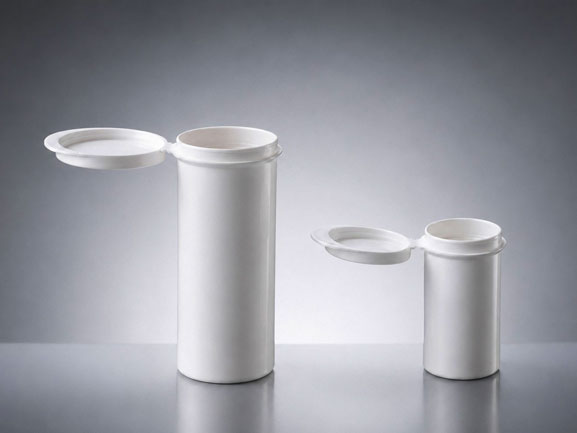
Option 2: Integrated Desiccant Vial
An integrated desiccant vial incorporates a molecular-sieve and PP moisture-absorbing material into the inner wall or an internal molded structure. Instead of concentrating the desiccant in the cap, the vial body provides a distributed moisture-absorbing surface around the packaged strips.
This format can be considered for diagnostic packaging projects that prioritize an integrated internal structure, reduced component handling and moisture control distributed along the product space.
Main Advantages of an Integrated Desiccant Vial
Distributed absorbing surface: Moisture-absorbing material can extend along the inner wall rather than being limited to the cap area.
No loose desiccant component: There is no separate sachet or canister inside the product space.
Reduced leakage and dust concerns: The desiccant is contained in a molded polymer structure designed to reduce powder shedding and loose-desiccant contact.
More closure design freedom: Moving the moisture-control function to the vial body can leave more options for closure and headspace design.
Simplified component handling: The moisture-control function is supplied as part of the container, which can support automated filling discussions.
Custom project positioning: Vial dimensions, adsorption level, opening design and label area can be reviewed for specific IVD packaging programs.
Points to Evaluate
Integrated desiccant vials may require more project-specific discussion around material structure, molding, dimensions and adsorption profile. Tooling and unit cost can differ from established desiccant-cap formats. The customer should also confirm that the molded desiccant material and vial construction are suitable for the intended strip chemistry, filling process and regulatory market.
Side-by-Side Comparison
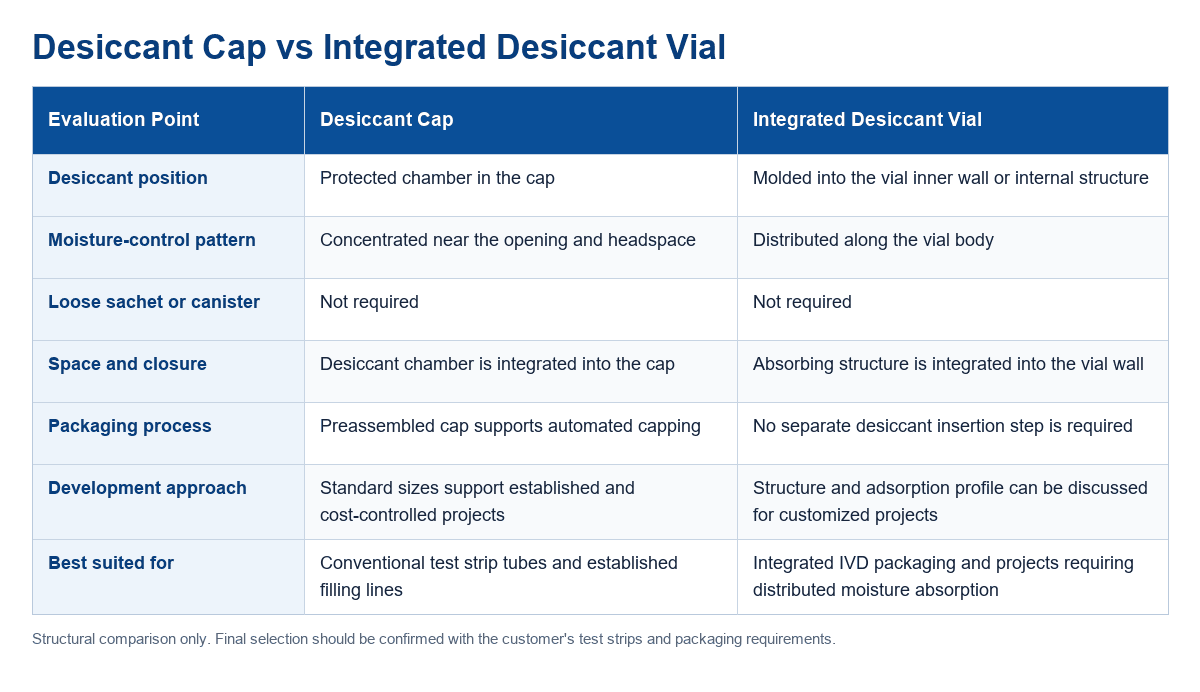
Both desiccant caps and integrated desiccant vials can provide effective moisture-control support for test strip packaging. Desiccant caps are a mature and flexible option for conventional test strip tubes, while integrated desiccant vials offer a distributed inner-wall absorbing structure and a more integrated packaging format.
The most suitable choice depends on the strip count, vial size, opening frequency, filling process, target market and packaging budget. Xinfuda supplies both solutions and can provide samples for customers to compare container fit, handling and moisture-control requirements before making a final selection.



Copyright © Shijiazhuang Xinfuda Medical Packaging Co., Ltd. All Rights
MAKE AN ENQUIRY