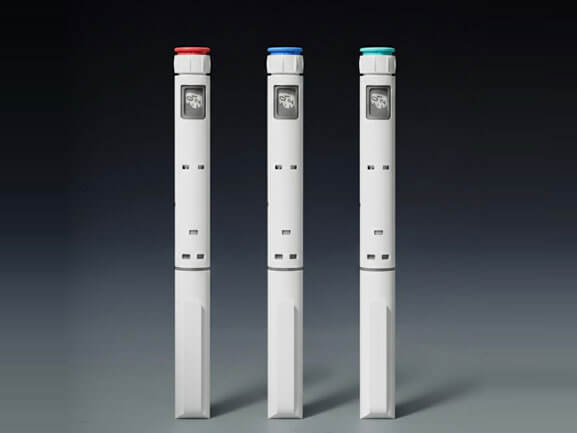
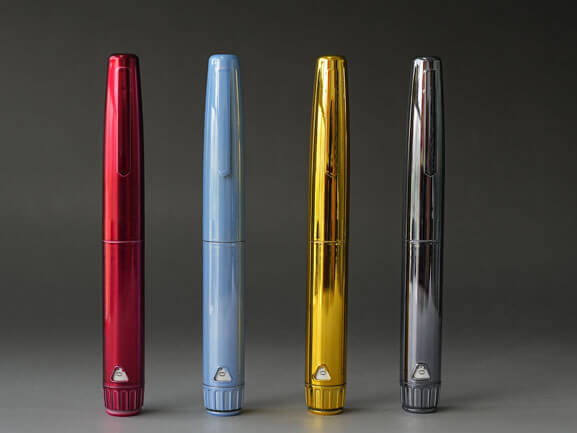
Choosing between a prefilled syringe (PFS), cartridge and vial is not only a packaging decision. The primary container can affect drug stability, filling operations, dose delivery, device development and the way a medicine is administered.
There is no universally superior format. The appropriate choice depends on the formulation, target dose, treatment frequency, storage conditions and intended user. This article provides a practical comparison for pharmaceutical, biotech and drug-delivery projects.
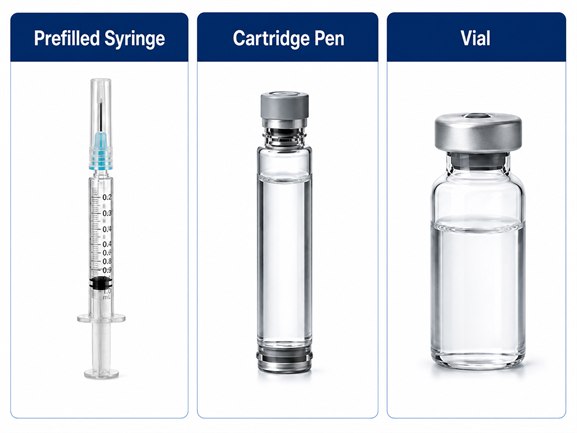
PFS vs Cartridge vs Vial: Quick Comparison
| Comparison Factor | Prefilled Syringe | Cartridge Pen | Vial |
| Administration workflow | Ready-to-administer single dose | Used with a pen injector or compatible device system | Requires withdrawal or reconstitution before injection |
| Preparation and dosing | Fewer preparation steps | Supports repeated or adjustable dosing | Flexible formulation and fill-volume options |
| Device integration | Standalone or integrated with an autoinjector | Requires a compatible pen or drug delivery device | Administration device is separate |
| Key evaluation points | CCI, siliconization, plunger movement and needle shield | Cartridge fit, stopper position, air bubbles and dose accuracy | Material compatibility, stopper, CCI, withdrawal and breakage |
| Typical applications | Fixed-dose biologics and self-injection projects | GLP-1, insulin, peptide and hormone therapy projects | Liquid or lyophilized injectables and clinical supplies |
Prefilled Syringe: Convenience With More Functional Interfaces
A PFS stores the drug and supports direct administration. It may be used as a standalone syringe or integrated into an autoinjector. Its main advantage is convenience: the dose is already filled, reducing preparation and withdrawal steps.
However, PFS development involves several moving and sealing interfaces. Project teams may need to evaluate:
Container closure integrity across the barrel, plunger and front closure.
Extractables and leachables from elastomeric or polymeric components.
Silicone oil, particles and biologic compatibility.
Break-loose force, glide force and delivered volume.
Compatibility with autoinjector activation and injection force.
PFS formats are often considered for fixed-dose products and self-injection, but their suitability must be demonstrated with the intended formulation and delivery device.
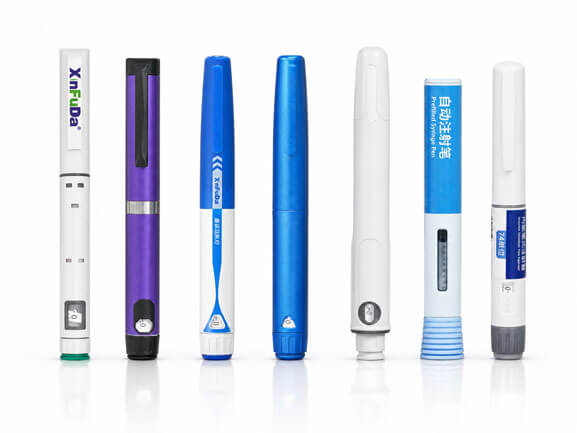
injecion pen types
Cartridge: Built Around the Injection Pen
A cartridge normally works as part of a reusable or disposable injection pen. The device controls dose setting, plunger movement and drug delivery, so the cartridge and pen should be developed as one connected system.
Cartridges are particularly relevant for repeated subcutaneous therapies and programs requiring fixed or adjustable doses. Key evaluation areas include:
Cartridge diameter, length, neck geometry and fill volume.
Plunger stopper dimensions and position.
Headspace and air-bubble control.
Dose increment, accuracy and injection force.
Compatibility with the pen drive mechanism and needle interface.
For small-volume or tight-tolerance doses, stopper position, trapped air and device mechanics may have a greater effect on dose delivery. Dual-chamber cartridges require additional evaluation of component separation, reconstitution and mixing. See Xinfuda's dual chamber cartridge pen platform.
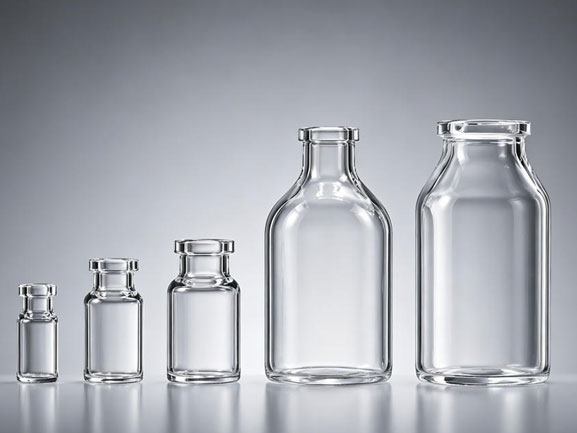
Vial: Flexible for Liquid and Lyophilized Products
Vials remain a versatile format for injectable products. They support different fill volumes and are widely used for liquid formulations, lyophilized drugs, clinical supplies and medicines administered by healthcare professionals.
Unlike PFS and cartridge systems, a vial separates storage from the delivery device. This creates additional preparation steps, such as withdrawal or reconstitution, but provides greater flexibility during development.
Important vial-selection factors include:
Glass or polymer material compatibility.
Stopper, seal and container closure integrity.
Extractables, leachables, particles and adsorption concerns.
Liquid, frozen or lyophilized storage requirements.
Break resistance, transport and filling-line compatibility.
Polymer containers may be evaluated when a project is concerned about glass breakage, surface interaction or low-temperature handling.


Copyright © Shijiazhuang Xinfuda Medical Packaging Co., Ltd. All Rights
MAKE AN ENQUIRY