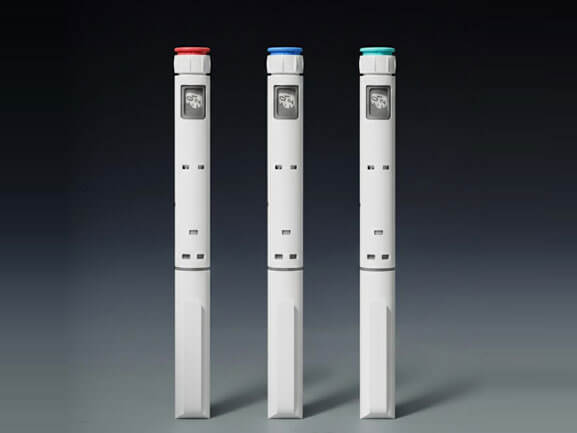
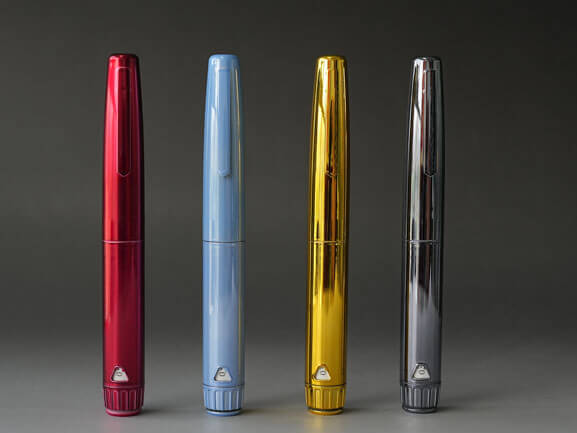
Two dual-chamber pen projects can start with the same basic requirement: keep a drug and diluent separated during storage, then combine them inside the cartridge before injection. Yet the finished products may feel very different in the user's hand.
In Xinfuda's current injection pen platform directions, the disposable dual-chamber pen uses a rotational action to initiate the reconstitution sequence. The reusable dual-chamber pen uses a button-controlled action with a replaceable cartridge. The visible difference is rotation versus pressing a button, but the real project decision goes further. It affects the device lifecycle, cartridge strategy, user instructions, assembly plan and recurring supply model.
For peptide brands, pharmaceutical development teams and device distributors, the right question is not which mechanism looks more advanced. It is which workflow fits the product that will actually be filled, supplied and used.
How the Rotation-Activated Disposable Direction Works
With the single-use dual-chamber cartridge pen, the user rotates the designated part of the device to initiate the internal movement required for reconstitution. The rotational action is intended to advance the mechanism in a controlled direction so the separated components can combine inside the dual-chamber cartridge.
A representative user sequence may include:
rotating the activation section as instructed;
allowing the diluent and drug component to combine;
completing the specified mixing or waiting step;
inspecting the reconstituted solution where required; and
preparing the intended dose and completing the injection.
The exact number of turns, direction of rotation, mixing time and dose-setting procedure depend on the final cartridge and device configuration. These details should be confirmed during development rather than copied from a general demonstration sample.
This direction can make sense when the brand wants the medicine cartridge and device to remain together as one product presentation. The customer does not need to plan a long-term pen body and replacement-cartridge relationship. However, the complete device becomes part of every finished product unit, so device assembly, labeling, packaging and recurring procurement must be planned at commercial scale.
How the Push-Button Reusable Direction Works
With the reusable dual-chamber pen, the pen body remains in service while a project-matched dual-chamber cartridge is replaced according to the intended treatment plan. After the cartridge is installed, the button action initiates the designed reconstitution sequence.
A representative user sequence may include:
loading the compatible dual-chamber cartridge into the pen body;
pressing the designated button to begin reconstitution;
allowing the separated components to combine and mix;
inspecting the solution according to the product instructions;
preparing the dose and injecting; and
replacing the cartridge when the defined cartridge-use cycle is complete.
This direction can fit products built around continued use, replacement cartridges or a durable branded device. It also adds responsibilities that are less prominent in a disposable presentation. The project team must define cartridge loading, orientation, replacement, priming, device care and the supply of later cartridges. A reusable pen is only commercially practical when the refill and support model is practical as well.
Rotation Versus Button Is a Workflow Decision
It is tempting to compare the two mechanisms only by asking which action is easier. That is too narrow. A rotation can be simple when the required movement, grip and feedback are clear. A button can be intuitive when its state and travel are easy to recognize. Either action can become confusing if the instructions, cartridge behavior and device feedback are not aligned.
The project team should evaluate the complete sequence around the activation step.
User action and feedback. Can the intended user complete the movement with the required grip and force? Is there clear visual, audible or tactile feedback that the activation step has reached its intended position?
Mixing and waiting. Does the formulation require gentle rolling, repeated movement or a defined waiting period? Could vigorous handling create foam or bubbles? The device action should not be treated as proof that the drug has fully dissolved.
Inspection. Can the user see the relevant part of the cartridge after activation? The instructions should define what an acceptable solution looks like and what to do if particles, foam or incomplete dissolution remain visible.
Dose preparation. Reconstitution does not replace priming, dose selection or other preparation steps that may be required by the final system. These tasks should be tested as one connected workflow.
Error recovery. The development team should consider what happens if the user stops halfway through the rotation, presses the button before the device is ready or attempts to inject before reconstitution is complete.
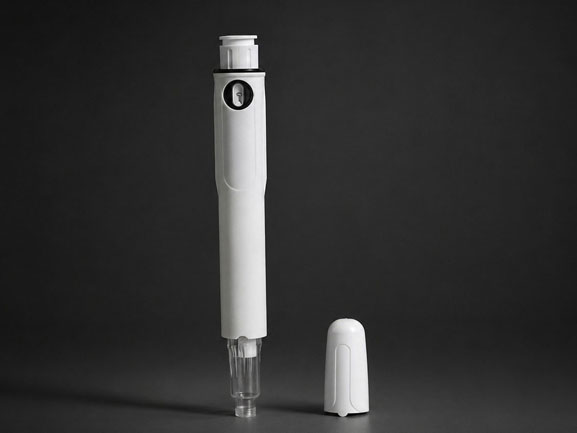
When the Disposable Direction Is More Likely to Fit
A rotation-activated disposable dual-chamber pen deserves early evaluation when the project has several of the following characteristics:
the cartridge and pen are intended to be supplied as one complete presentation;
the user should not load or replace a medicine cartridge;
the brand prefers each new cartridge to arrive with a new device mechanism;
the product plan supports repeated procurement of complete pen units;
the filling and assembly partners can manage cartridge installation and final-device packaging; and
the activation sequence can be expressed clearly through a rotation-based workflow.
This does not mean that the formulation is automatically compatible with a disposable pen. Cartridge dimensions, bypass and stopper behavior, fill volumes, mixing performance, delivered dose and final injection performance still require project-specific evaluation.
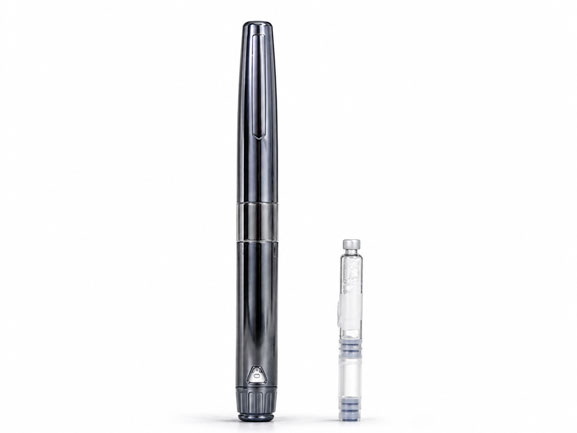
When the Reusable Direction Is More Likely to Fit
A push-button reusable dual-chamber pen deserves early evaluation when the project has several of these characteristics:
the pen body is intended to remain with the user across multiple cartridge cycles;
replacement dual-chamber cartridges are part of the commercial supply plan;
the product is positioned around continued use or a durable branded device;
the user or trained operator can complete cartridge loading and replacement;
the brand can support starter kits, refill packs and device replacement; and
the button-controlled activation sequence fits the intended preparation workflow.
The reusable route should not be selected only because the device appears more premium. Its value depends on a workable cartridge ecosystem, clear replacement instructions and a realistic forecast for both pen bodies and refill cartridges.
The Cartridge Remains the Starting Point
Neither activation method can be selected independently of the dual-chamber cartridge. Nominal capacity alone is not enough to determine compatibility. An initial review should include:
the cartridge drawing and dimensional tolerances;
chamber allocation and target fill volumes;
stopper positions and stopper travel;
bypass geometry and transfer sequence;
headspace and closure configuration;
formulation presentation before and after reconstitution;
expected mixing time and visual acceptance criteria;
target delivered volume, dose range and dose increment; and
intended needle and injection conditions.
For a reusable project, the review must also cover repeated cartridge loading and removal. For a disposable project, it must cover how the cartridge is installed and retained during final-device assembly. A cartridge that physically fits is not yet a validated drug-device combination.
A Practical Way to Choose the First Evaluation Sample
Customers often request both platforms before defining what the sample should prove. A more useful approach is to start with the intended commercial presentation.
Choose the disposable sample first when the main question is whether the drug cartridge can be integrated into a complete device that will be supplied with every medicine unit. The early review should focus on rotational activation, cartridge installation, device assembly and the finished-pack concept.
Choose the reusable sample first when the main question is whether one durable pen can support a continuing series of replacement dual-chamber cartridges. The early review should focus on cartridge loading, button activation, dose preparation, cartridge replacement and the refill model.
If the commercial direction is still open, both samples can support a structured feasibility comparison. They should not be compared only by appearance or by performing the activation step with an empty demonstration cartridge. The evaluation objective, representative cartridge and expected user sequence should be defined before conclusions are drawn.
Information to Send Before a Dual-Chamber Pen Discussion
To make the first technical discussion productive, provide:
whether the components are lyophilized-plus-liquid or liquid-plus-liquid;
the dual-chamber cartridge drawing and nominal capacity;
chamber fill volumes, stopper and bypass information;
the required reconstitution and mixing procedure;
viscosity and appearance after reconstitution;
target delivered dose and dosing frequency;
intended user and use environment;
preference for a complete disposable unit or a reusable pen with refills;
target market, project stage and sample purpose; and
forecast for the first order and expected recurring demand.
These inputs help separate a platform demonstration from a real project evaluation.
Two Platforms, One Portfolio
The rotation-activated disposable pen and the push-button reusable pen are not competing versions of the same commercial plan. They are two ways to build an in-pen reconstitution product around different device lifecycles.


Copyright © Shijiazhuang Xinfuda Medical Packaging Co., Ltd. All Rights
MAKE AN ENQUIRY