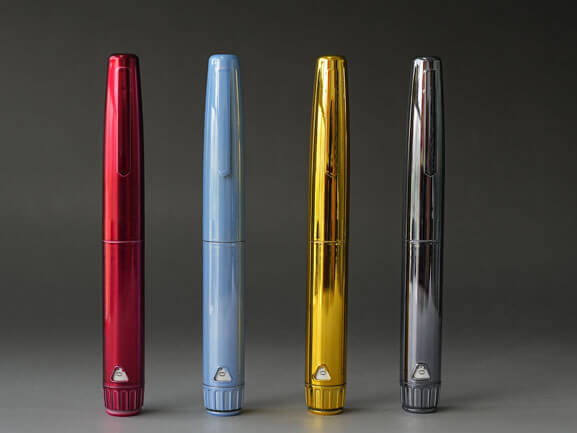
For pharmaceutical companies, selecting an injection device is no longer only a packaging decision. The device influences patient operation, product positioning, combination-product development and the commercial life cycle of the drug.
Among the available self-injection systems, autoinjectors are increasingly considered for fixed-dose biologics, peptides and other subcutaneous injectable products. Their appeal comes from the combination of a prefilled primary container, simplified activation and a patient-friendly injection process.
Fewer Steps for the Patient
A conventional pen injector may require the patient to install a needle, prime the device, select a dose and maintain pressure during injection.
A typical single-dose autoinjector simplifies the sequence:
Remove the protective cap
Place the device against the injection site
Activate and hold until delivery is complete
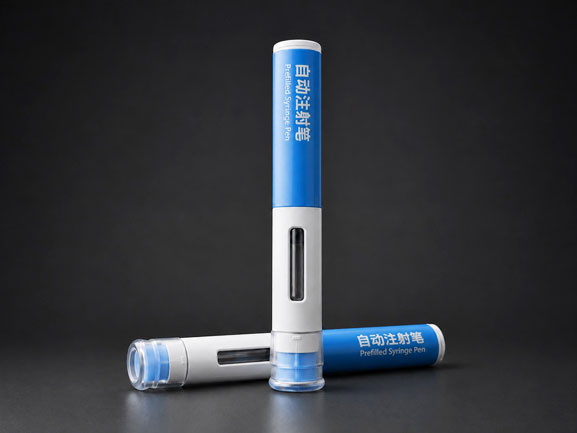
Needle insertion and drug delivery can be completed automatically. The hidden-needle structure may also make the device more acceptable to patients who are uncomfortable seeing or handling a needle.
However, simplifying the visible operation does not eliminate development requirements. FDA guidance emphasizes that critical user tasks must be identified and evaluated through the human-factors engineering process for drug-device combination products. FDA human-factors guidance
A Natural Platform for Fixed-Dose Products
Autoinjectors are generally designed around a single, preset dose. This makes them particularly relevant when the pharmaceutical product does not require patient-specific dose adjustment.
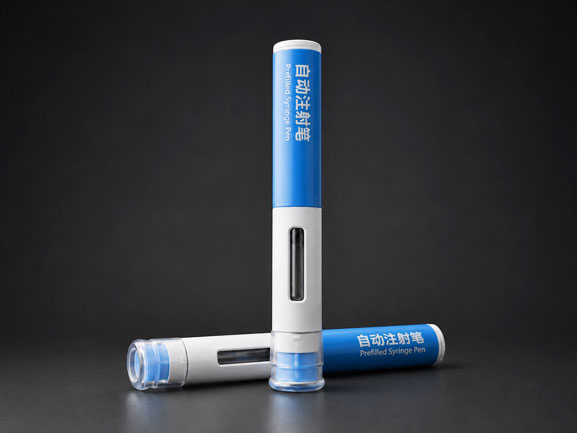
The drug is commonly supplied in a prefilled syringe, or PFS, installed inside the autoinjector. Once activated, a spring-driven mechanism advances the syringe and delivers its contents.
For pharmaceutical developers, a PFS-based configuration can provide a clear separation of functions:
The PFS contains and protects the drug product
The autoinjector controls activation, needle insertion and delivery
The outer device provides the patient interface and needle protection
ISO 11608-1 covers needle-based injection systems incorporating prefilled or replaceable containers, while ISO 11608-5 addresses automated functions such as needle hiding, needle insertion, drug delivery and needle shielding. ISO 11608-1, ISO 11608-5
Supporting the Move Toward Self-Administration
Many biologic products require repeated subcutaneous administration. When the formulation, dose volume and delivery time are compatible with an autoinjector, the device may support administration outside a traditional clinical setting.
This is commercially important for pharmaceutical companies seeking to develop a treatment experience that is less dependent on healthcare-professional operation.
The benefits are not limited to convenience. A well-designed device can become part of the product’s overall value proposition by supporting:
More consistent operating steps
Reduced needle visibility
Clear activation and end-of-dose feedback
A recognizable branded device format
A differentiated presentation from a stand-alone PFS
Autoinjectors are regulated as drug-device combination products in major markets, so device selection, risk analysis, usability and technical documentation must be considered alongside the drug development program. FDA combination-product resources
Product Differentiation and Life-Cycle Planning
A pharmaceutical company may initially commercialize an injectable drug in a vial or prefilled syringe. Introducing an autoinjector presentation later can create an additional product configuration for selected markets or patient groups.
This can support product life-cycle planning by allowing the company to:
Extend the drug into a self-injection presentation
Differentiate the product from conventional syringe administration
Develop a proprietary color, label and device appearance
Address patients who prefer a simpler fixed-dose format
Build a more recognizable drug-delivery platform
For this reason, device discussions often begin before the final commercial presentation is confirmed. PFS dimensions, fill volume, viscosity, injection time and activation force can all influence the final design.
When an Autoinjector Is Not the Best Choice
Autoinjectors are not the universal answer for every injectable product.
A different pen platform may be more appropriate when the project requires:
Project requirement More suitable device direction
Adjustable or titrated dosing Variable-dose disposable pen
Multiple doses from one cartridge Disposable or reusable 3 mL cartridge pen
Long-term replacement-cartridge use Reusable injection pen
Lyophilized drug and diluent separation Dual-chamber cartridge pen
Large delivery volume or long injection time On-body delivery system evaluation
Single preset dose in a PFS Autoinjector
The correct decision therefore starts with the formulation and primary container, not the appearance of the device.


Copyright © Shijiazhuang Xinfuda Medical Packaging Co., Ltd. All Rights
MAKE AN ENQUIRY