Vial and Dual-Chamber Cartridge Processes Are Not Interchangeable
| Process Area | Vial-Based Presentation | Dual-Chamber Cartridge Direction | Main Project Question |
| Container geometry | One main drug chamber | Two consecutive chambers with project-specific stopper positions | Can the components, headspace and stoppers fit the selected cartridge? |
| Component separation | Drug and diluent may use separate containers | Components remain separated within one cartridge | How will separation be maintained during filling, storage and handling? |
| Lyophilization | Product is freeze-dried in the vial | Lyophilization must be planned for the selected cartridge chamber | Can the filling and lyophilization partner support the cartridge format? |
| Diluent filling | Separate vial, ampoule or syringe may be used | Diluent is filled into the second chamber | How will fill volume, headspace and stopper placement be controlled? |
| Closure sequence | Vial stopper and seal | Multiple stopper functions plus final closure | Which components are drug-contact parts and how will they be assembled? |
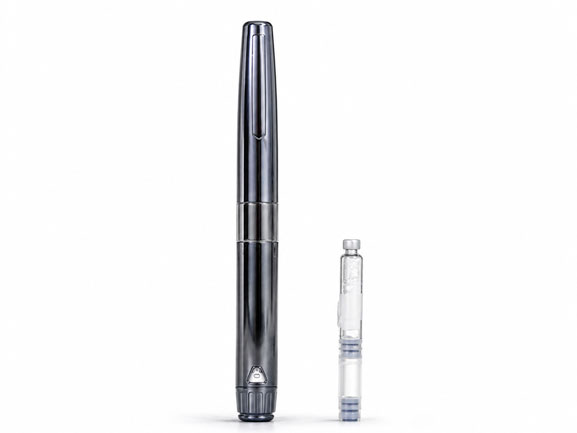
| Device integration | Administration device may be separate | Finished cartridge must fit and operate within the pen | Do dimensions, tolerances and stopper travel match the device mechanism? |
1. Cartridge Geometry Becomes a Process Input
For a vial, the drug chamber and closure are usually the main geometric references. A dual-chamber cartridge adds chamber allocation, intermediate stopper position, bypass location, neck and closure geometry, and the travel required during activation.
These dimensions influence both manufacturing and device fit. A nominal cartridge capacity is not enough. The team should work from a controlled drawing with tolerances and component specifications.
2. Chamber Allocation Must Be Defined Early
The product owner and fill-finish partner should define which chamber contains the lyophilized peptide and which contains the diluent. Fill volumes, headspace and stopper positions should be planned together with the required reconstitution volume.
The final mixed volume is not automatically the same as the delivered volume. Residual volume, priming and device travel must be considered during dose planning.
3. Lyophilization Feasibility Must Be Revisited
A cycle developed for a vial should not be assumed to transfer unchanged to a cartridge. Container geometry, heat and mass transfer, fill depth, stopper position and equipment handling may differ.
The qualified formulation and lyophilization team should determine whether cycle development or adaptation is required. The device supplier can provide dimensional and functional inputs but should not make drug-process claims without project data.
4. Stopper and Bypass Functions Connect Manufacturing to Reconstitution
The intermediate stopper maintains component separation before use. During activation, its position relative to the bypass allows the diluent to enter the peptide chamber.
The project should review:
initial and final stopper positions;
placement tolerances;
break-loose and glide behavior;
bypass location and transfer path;
risk of premature communication between chambers; and
compatibility of elastomer components with the formulation.
These are connected container, process and device questions rather than isolated component specifications.
5. Inspection and Handling Requirements May Change
A cartridge has different dimensions and viewing areas from a vial. Cosmetic inspection, visible-particle inspection, stopper-position checks and handling systems may therefore require a different approach.
If the user must inspect the product after reconstitution, the device and cartridge holder should preserve the necessary viewing area. Labels or decorative components should not block critical inspection zones.
6. The Finished Cartridge Must Be Tested in the Device
An empty dimensional sample can support early fit checks, but it cannot confirm the final drug-device performance. Representative filled cartridges should eventually be evaluated for activation, reconstitution, priming, dose delivery and injection performance according to the project plan.
The final verification strategy should connect drug-product quality, container closure performance and device-delivery outputs.
Prepare for a More Useful Supplier Discussion
Before requesting a reusable dual chamber cartridge pen evaluation, prepare the cartridge drawing, chamber allocation, target fill volumes, stopper and bypass information, lyophilization status, post-reconstitution properties and intended dose.


Copyright © Shijiazhuang Xinfuda Medical Packaging Co., Ltd. All Rights
MAKE AN ENQUIRY