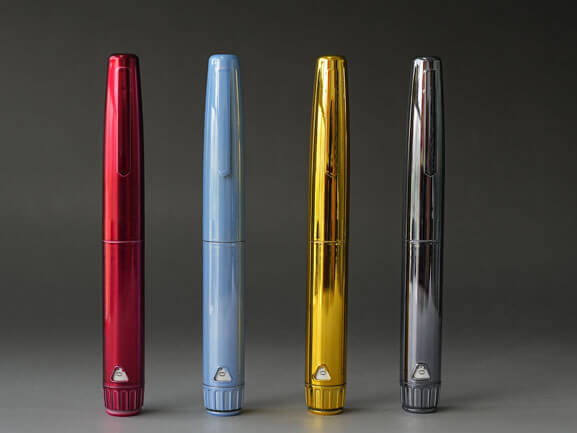
For pharmaceutical companies developing GLP-1, peptide, insulin or biologic therapies, the injection device is not only a container for the drug. It influences dose delivery, user operation, packaging design, training requirements, project cost and the overall drug-device combination strategy.
Two common options are pen injectors and autoinjectors. Both are designed to support subcutaneous self-injection, but they serve different project needs. A pen injector usually gives the user more control over dose setting and injection operation, while an autoinjector is designed to simplify the injection process through a more automated mechanism.
Choosing between the two should depend on the drug formulation, dose range, cartridge or container format, target user group, regulatory expectations, cost structure and commercialization plan.
A pen injector is a handheld injection device commonly used for repeated or fixed-dose subcutaneous administration. It may be disposable, reusable, prefilled or cartridge-based. In many projects, the user sets or confirms the dose, attaches or uses a compatible needle, inserts the needle into the injection site and activates the injection manually.
Pen injectors are widely used for insulin, GLP-1 drugs, peptide therapies, hormone therapies and other injectable products that require accurate dosing and convenient patient operation.
For GLP-1 and peptide projects, a pen injector can be suitable when the drug requires a clear dose display, variable-dose control, cartridge compatibility or a device platform that can be customized for different markets and treatment plans.
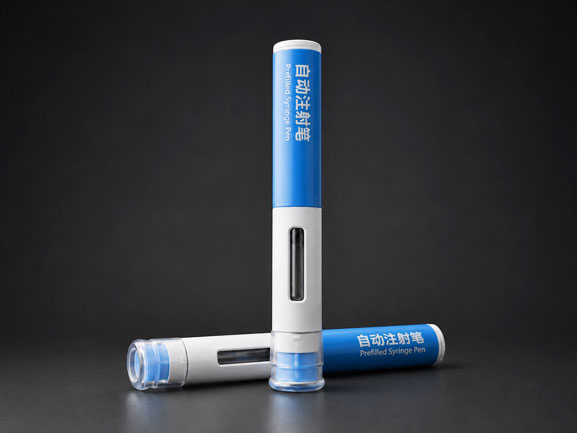
An autoinjector is a self-injection device designed to automate key parts of the injection process. In many autoinjector designs, the user places the device against the injection site and activates it with a button or push-on-skin mechanism. The device then inserts the needle and delivers the dose automatically.
Autoinjectors are often used when simplified operation, reduced needle visibility, patient confidence and step reduction are important. They are common in biologic drug delivery, emergency therapies and home-use injectable treatments where the user may have limited training or may prefer a more guided injection experience.
Compared with a pen injector, an autoinjector can provide a more controlled and automated user experience, but it may also involve higher device complexity, different container requirements and higher development cost.
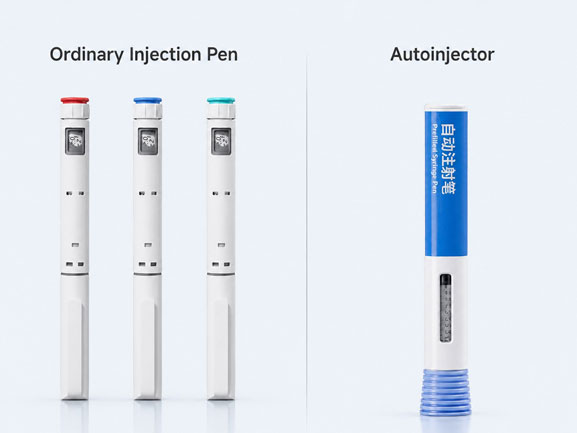
Pen vs Antoinjector
| Factor | Pen Injector | Autoinjector |
|---|---|---|
| User control | Usually more user-controlled dose setting and injection operation | More automated injection process |
| Typical dose style | Fixed dose or variable dose depending on design | Often fixed dose, depending on device platform |
| Needle experience | Needle may be visible before or during use | Needle can be hidden in many designs |
| Device complexity | Generally simpler mechanical structure | More complex mechanism |
| Training requirement | Requires clear instructions for dose setting, needle handling and injection steps | Designed to reduce user steps and simplify injection |
| Cost consideration | Often more cost-efficient for certain projects | Usually higher device and development cost |
| Best suited for | GLP-1, insulin, peptide and dose-adjustable therapies | Biologics, fixed-dose therapies and user-friendly home injection projects |
A pen injector may be preferred when the project requires dose flexibility, cartridge compatibility or a more cost-effective platform for repeated use.
For GLP-1 and peptide drug delivery, pen injectors are often considered when the dose needs to be selected, displayed or adjusted according to the treatment plan. A pen format can also support a familiar user experience for patients who are already used to insulin pens or other self-injection devices.
Pen injectors may be suitable for projects that require:
Variable-dose or multi-dose operation
3mL cartridge compatibility
Disposable or reusable device options
Clear dose display and dose confirmation
OEM or private label customization
Practical cost control for commercial supply
Project-specific color, label and branding requirements
For pharmaceutical buyers, the pen injector is often attractive because it can balance usability, dose control and manufacturing practicality. Learn more about Xinfuda's injection pen platform.
An autoinjector may be preferred when the project focuses on simplified operation, patient confidence and reduced injection steps.
For some biologic therapies, patients may be less familiar with self-injection. A hidden-needle autoinjector can reduce anxiety and make the injection process easier to follow. The device can also help standardize the injection sequence by automating needle insertion and dose delivery.
Autoinjectors may be suitable for projects that require:
Fixed-dose delivery
Fewer user steps
Hidden needle design
Push-button or push-on-skin activation
A more guided home-use experience
A strong focus on patient confidence
Differentiated premium device positioning
However, an autoinjector is not always the best answer. The higher mechanical complexity and project cost should be considered carefully, especially when a pen injector can already meet the dosing and usability requirements. See Xinfuda's autoinjector pen options for related project discussion.
GLP-1 therapies are often used in long-term treatment programs. This makes convenience, dose accuracy, patient adherence and clear instructions especially important.
For many GLP-1 and peptide projects, pen injectors remain a practical option because they can support dose setting, dose display, cartridge-based designs and scalable OEM customization. A pen injector platform can be especially useful when the project requires different dose strengths, regional labeling or product-line expansion.
Autoinjectors may be considered when the therapy is positioned around simplified use, fixed-dose delivery or a premium patient experience. For some user groups, reducing visible needle exposure and simplifying the injection sequence may be important advantages.
The final decision should be based on the drug's dose volume, viscosity, cartridge or container format, intended user population, treatment frequency and commercial strategy. For GLP-1 and semaglutide-related projects, visit Xinfuda's semaglutide injection pen page.
Peptide and biologic drugs can be sensitive to formulation, storage, dose accuracy and delivery conditions. The device selection process should not only compare the outer appearance of a pen injector and an autoinjector. It should also evaluate the full drug-device project requirements.
Key questions include:
Is the drug intended for fixed-dose or variable-dose administration?
What is the required dose volume and dose increment?
Will the project use a cartridge, prefilled container or other primary packaging format?
Does the user need to see and confirm the dose?
Is needle hiding important for the target patient group?
What level of training will be available?
What are the target market and regulatory requirements?
What is the expected annual volume and cost target?
Does the supplier support samples, customization and documentation discussions?
These questions help the project team avoid choosing a device based only on appearance or market trend.
Before choosing a pen injector or autoinjector, pharmaceutical companies should review the following points with the device supplier:
Drug formulation characteristics
Dose volume and dose accuracy requirements
Fixed-dose or variable-dose strategy
Cartridge or container compatibility
Needle interface and user operation
Device material and mechanical structure
Labeling, color and brand customization
Sample evaluation requirements
Manufacturing scalability
Quality system and documentation support
For regulated drug delivery projects, early discussion between the pharmaceutical team and device supplier can reduce redesign risk and improve project efficiency.


Copyright © Shijiazhuang Xinfuda Medical Packaging Co., Ltd. All Rights
MAKE AN ENQUIRY